

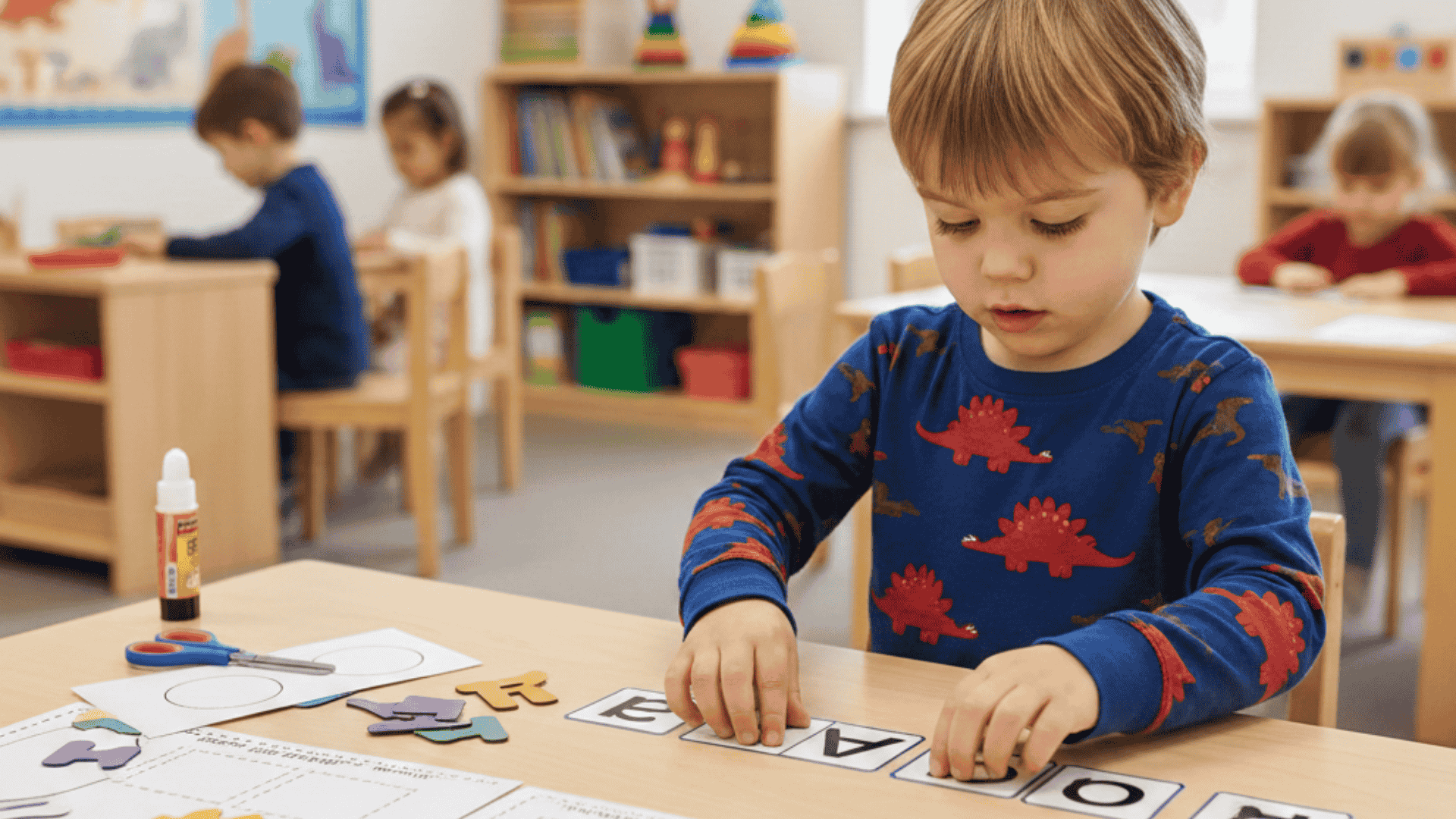
Finding the right activities for kindergarten can feel overwhelming. There are so many worksheets, printables, and resources that it can be difficult to know where to start.
Every child is different, and what works for one kid might not work for another. Here is a wide range of activities for kindergarten covering literacy, math, fine motor skills, science, social-emotional learning, and more.
Each one is designed to give kids focused, hands-on practice without making learning feel like a chore. A child just starting out or one who needs a little extra practice will find something useful here.
The goal is simple. Help kids build real skills through activities that are easy to use and worth coming back to.
Why Printable Activities for Kindergarten Work so Well
Printable activities for kindergarten are popular for good reason; they work. For parents and teachers, there is almost no prep time required. Print, hand over, done.
Each worksheet is built around real skills. Counting, letter recognition, tracing, and matching, these are the building blocks kids need before first grade. Kindergarten activities like these follow a natural learning progression.
There’s also no screen involved. Kids get hands-on practice with a pencil, which builds fine motor skills alongside academic ones.
Perhaps most importantly, printables give children something they can do on their own. A child who can sit down and work through an activity independently is building focus and confidence at the same time.
How to Choose the Right Kindergarten Activities for Your Child
Not every activity works for every child. Knowing what to look for helps you choose kindergarten activities that actually match your child’s needs.
- Skill Level: Choose activities that match what your child already knows, with just enough challenge to keep them growing.
- Attention Span: Shorter tasks work better for kids who lose focus quickly. Gradually build up to longer kindergarten activities.
- Learning Style: Some kids learn best by seeing, while others learn best by doing. Pick printables that match how your child takes in new information.
- Printable Vs Hands-On: Worksheets suit quiet practice time, while hands-on activities for kindergarten work better when kids need to move and engage physically.
- Independent vs Guided Work: Some activities are designed for solo practice. Others work better when a parent or teacher sits alongside the child for support.
Literacy Activities
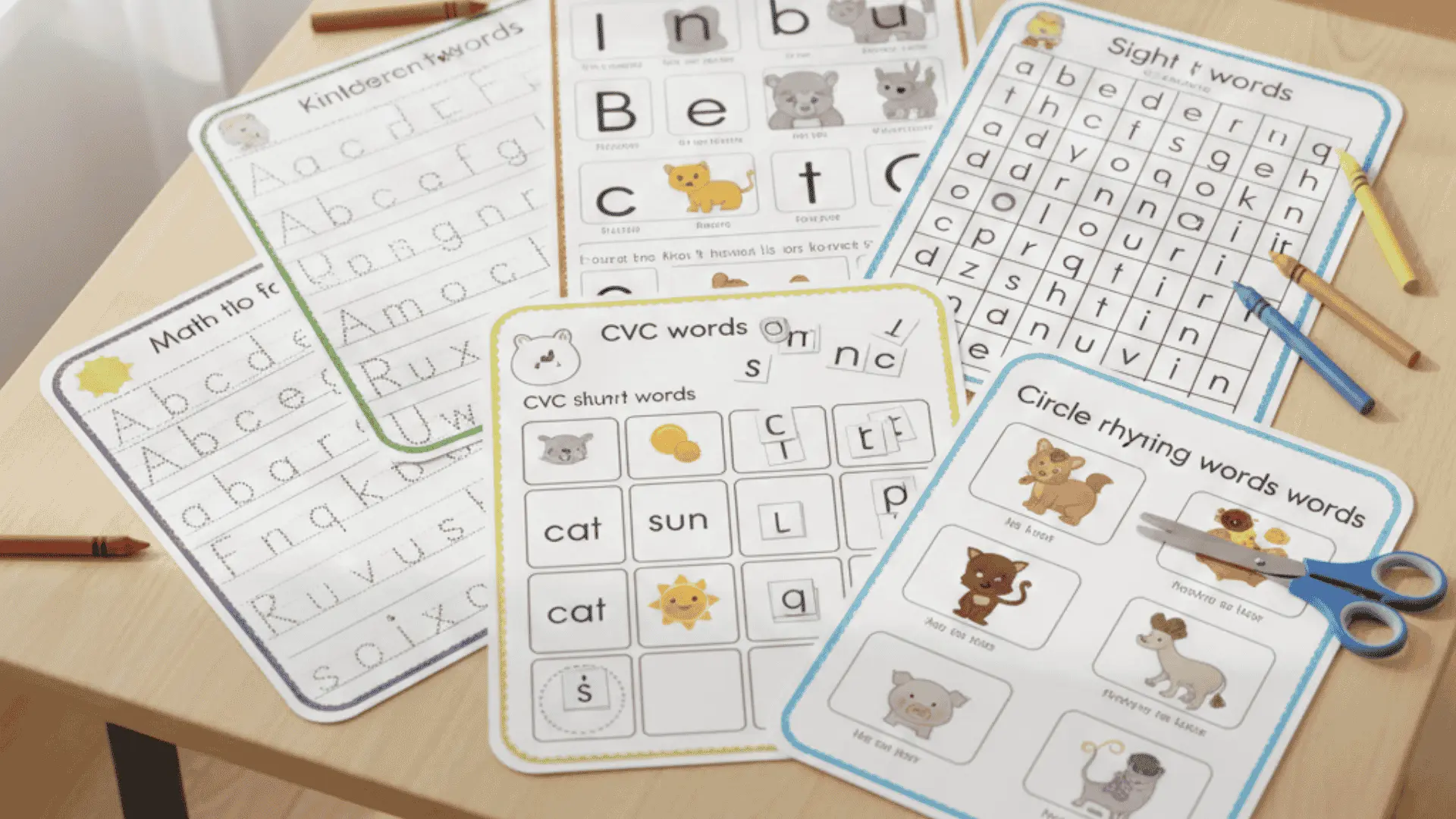
These printable literary activities for kindergarten cover the key reading and writing skills young learners need. From letters to simple sentences, each worksheet gives kids focused, hands-on practice.
1. Alphabet Tracing Worksheets
Tracing is one of the best ways for kids to learn letter formation. Each worksheet guides a child’s pencil stroke by stroke. Over time, that repetition builds muscle memory.
These are great for early writers who are still getting comfortable holding a pencil. They work well as morning warm-ups or quiet seat work.
2. Uppercase and Lowercase Letter Matching
Kids often learn uppercase letters first, so connecting them to lowercase versions is an important step. These matching activities for kindergarten use lines, colors, or cut-and-paste formats to make the link clear.
It’s a simple concept, but it takes practice. Regular repetition helps it stick without feeling like a chore.
3. Beginning Sounds Cut and Paste
This activity asks kids to listen carefully to the first sound in a word and then match it to the correct letter. Cutting and pasting adds a hands-on element that keeps kids focused.
It also builds phonemic awareness, which is a skill that directly supports reading development in the early grades.
4. Sight Word Search Printables
Sight words are common words that kids need to recognize at a glance, without sounding them out. Word search printables give kids repeated exposure to these words in a low-pressure format.
Finding the words in a grid reinforces visual recognition. It’s a quiet, focused kindergarten activity that fits easily into any routine.
5. CVC Word Building Worksheets
CVC stands for consonant-vowel-consonant. Think of words like “cat,” “big,” and “hop.” These worksheets help kids practice blending letter sounds together to form real words.
Blending is a major milestone in early reading. These printables break it down into small, manageable steps that make sense to young learners.
6. Rhyming Words Matching Activity
Rhyming helps kids hear patterns in words, which supports both reading and spelling later on. In these matching activities, kids connect word pairs that sound alike.
The format is straightforward and works well for independent practice. It can also spark conversations about word families, which naturally extend the learning.
7. Letter Sound Coloring Pages
These pages combine phonics practice with coloring, which gives kids a natural reason to stay engaged. A child might color all pictures that start with the letter “B” in blue, for example.
It reinforces letter-sound connections without feeling like a standard worksheet. A good option for kindergarten activities at home or in centers.
8. Missing Letter Fill-In Sheets
These worksheets show a word with one or more letters left out. The child fills in the blank. It asks kids to think about spelling patterns and letter order.
This kind of activity works well once kids have a basic grasp of the alphabet and are ready to apply what they know.
9. Sentence Building Cut and Glue
Kids cut out individual words, arrange them to form a complete sentence, and glue them down. This activity teaches word order and basic sentence structure in a hands-on way.
It also gives children a sense of accomplishment when the sentence comes together. A strong option for early writing activities for kindergarten.
10. Picture and Word Matching Worksheets
Children look at a picture and match it to the correct written word. This builds vocabulary and helps kids connect what they see to how it looks in print.
It’s a natural step toward independent reading. These sheets are simple to use and work well as a warm-up or a quick review activity.
By using interactive games, storytelling, and phonics exercises, children build a strong foundation for early reading success.
Math Activities
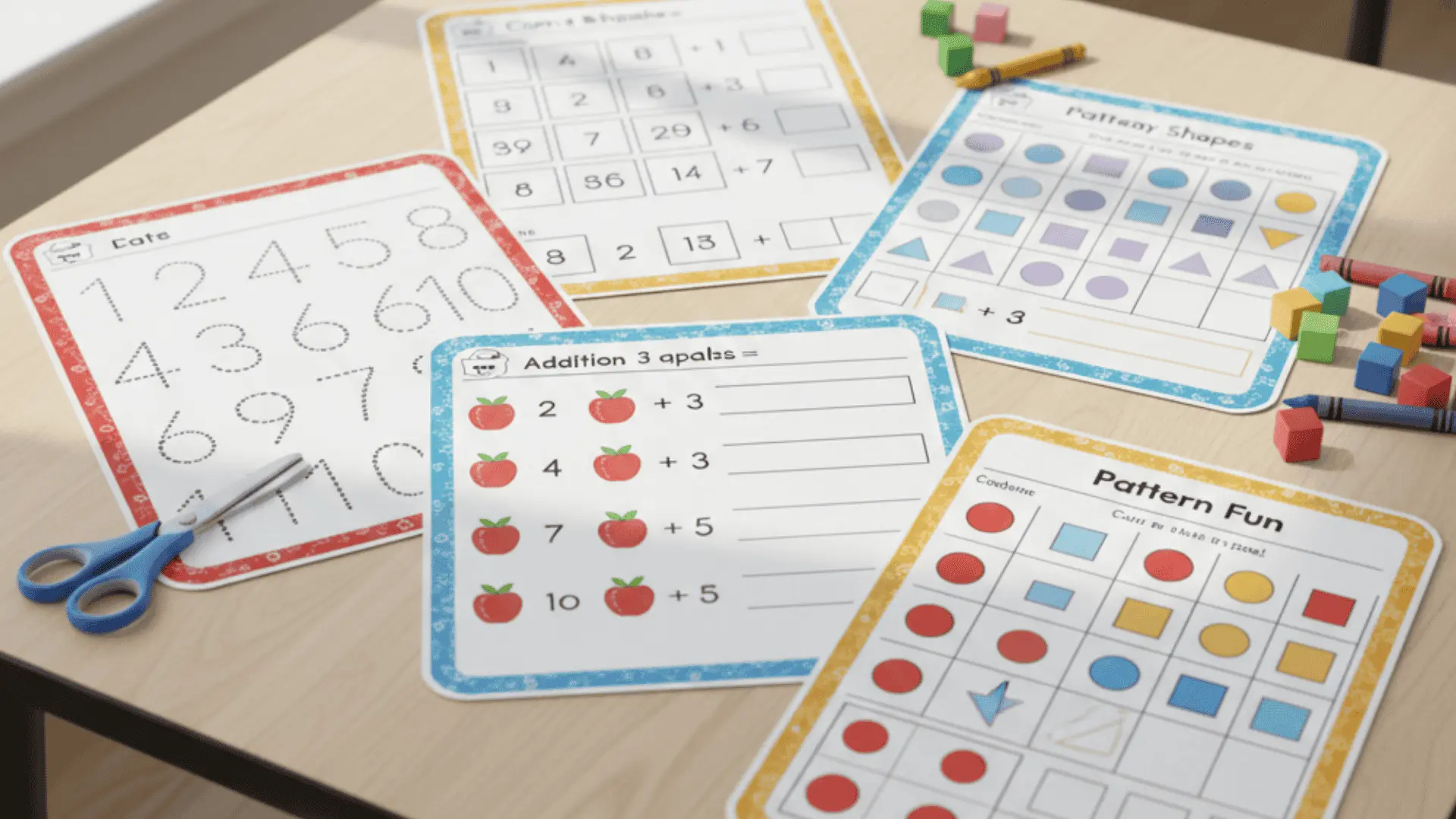
These printable math activities for kindergarten introduce numbers, shapes, and basic operations in a way that young learners can follow. Each worksheet builds on foundational skills kids need before first grade.
11. Number Tracing
Learning to write numbers takes just as much practice as learning to write letters. These tracing sheets guide kids through each number, one at a time.
The repetition helps with both recognition and formation. They work well as a daily warm-up and are simple enough for kids to complete on their own.
12. Count and Color Worksheets
These worksheets ask kids to count a group of objects and then color a matching number of them. It connects counting to a visual, hands-on task.
This is one of the more approachable kindergarten activities for building number sense. Kids get to use crayons, which makes it feel less like structured work.
13. Ten Frame Counting Printables
A ten-frame is a simple grid with two rows of five boxes. Kids place or draw dots to show a number. This visual tool helps children understand how numbers relate to ten.
It lays the groundwork for addition and subtraction later on. A solid choice for early math activities for kindergarten.
14. Shape Identification Worksheets
These sheets introduce basic shapes like circles, squares, triangles, and rectangles. Kids learn to name, trace, and spot them in everyday objects.
Shape recognition is an early geometry skill that shows up across many subjects. These printables keep the focus simple and clear without overwhelming young learners.
15. Patterns Cut and Paste Activity
Kids look at a pattern, figure out what comes next, and paste the correct piece to continue it.
This builds logical thinking and sequencing skills. Pattern work is a core part of kindergarten math.
The cut-and-paste format keeps kids engaged and adds a hands-on step to what could otherwise be a passive activity.
16. Simple Addition Worksheets
These worksheets introduce addition using pictures, numbers, or both. Kids count two groups of objects and write the total. It’s a concrete way to understand what adding actually means.
Starting with visual support makes the concept click faster. These are practical, focused activities for kindergarten that build early math confidence.
17. Subtraction Within 10 Printables
Subtraction can be tricky for young kids, so starting with 10 keeps it manageable. These printables use pictures to show kids taking away objects from a group.
Seeing the process visually helps children grasp the idea before moving to abstract numbers. It’s a steady, clear way to introduce the concept.
18. Comparing Numbers (Greater or Less)
Comparing numbers helps kindergarten students understand number relationships and build early math skills. Through fun activities such as number cards, counting objects, and worksheets, children learn to identify whether a number is greater, smaller, or equal.
These activities strengthen number sense and help young learners build confidence in basic math concepts.
19. Skip Counting by 2s and 5s
Skip counting is an early step toward multiplication and helps kids see number patterns. These worksheets guide children through sequences, filling in missing numbers as they go.
Counting by 2s and 5s also supports telling time and counting coins later on. It’s a practical skill worth practicing early.
20. Measurement with Nonstandard Units
Instead of rulers, kids measure objects using paper clips, cubes, or other everyday items. This introduces the concept of measurement in a way that makes sense to young learners.
It also encourages kids to compare lengths and sizes. A hands-on approach that works well as a standalone activity or part of a wider math lesson.
Math activities help kindergarten children develop essential skills like counting, number recognition, and problem-solving in a fun and engaging way. Through hands-on games, worksheets, and interactive exercises, kids build confidence and a strong foundation in early math concepts.
Fine Motor and Handwriting Activities
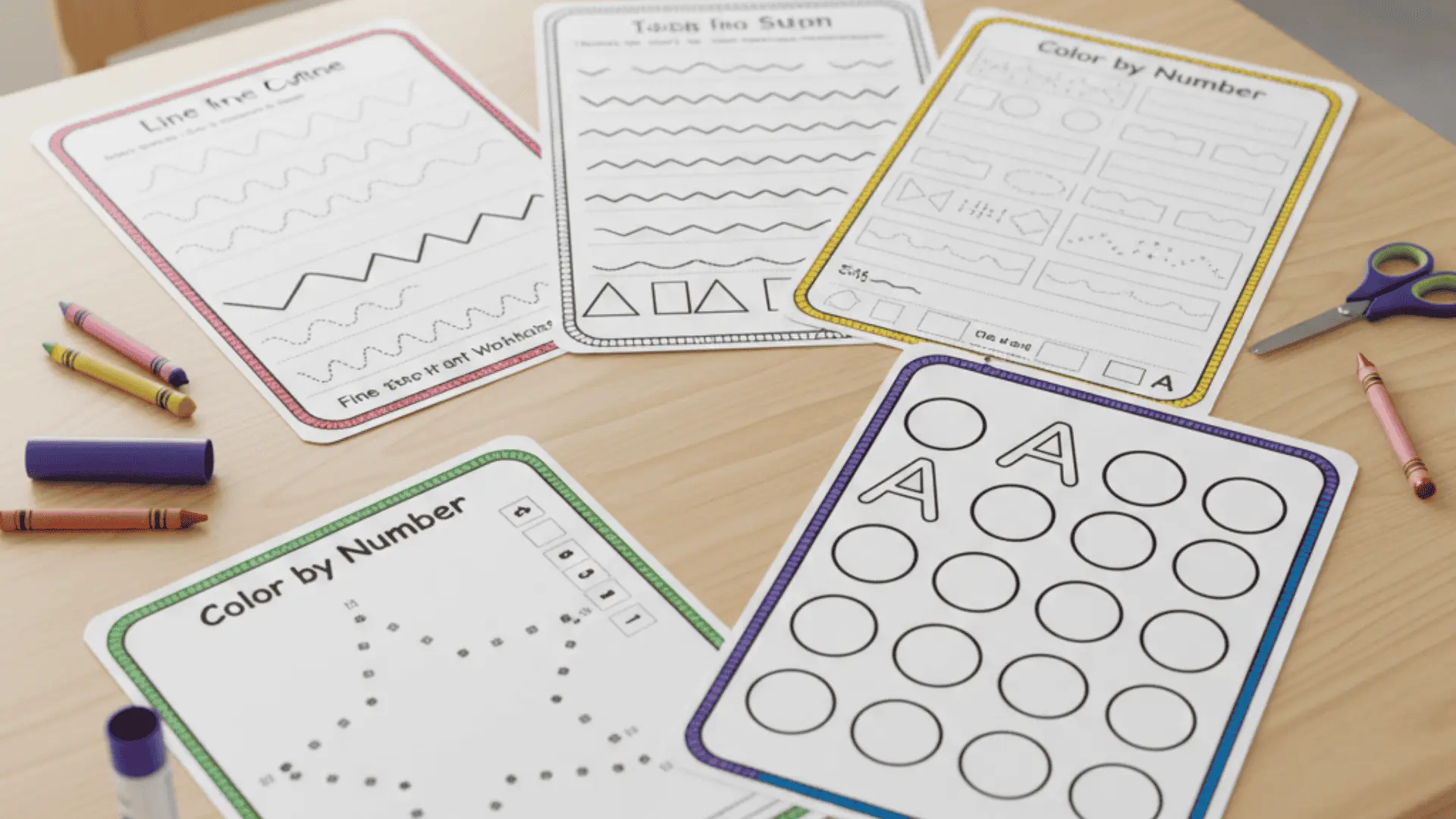
These printable fine motor and handwriting activities for kindergarten help kids build the hand strength and control they need for writing, cutting, and everyday classroom tasks.
21. Line Tracing Practice Sheets
Before kids can write letters, they need to control a pencil. Line tracing sheets start with simple straight lines and move toward curves and diagonal strokes.
Each page gives kids low-stakes practice that builds confidence over time. These are some of the most useful activities for kindergarten students in building early writing readiness.
22. Scissor Skills Cutting Strips
Using scissors correctly takes coordination that young children are still developing. These pages include lines, curves, and shapes for kids to cut along at their own pace.
Regular practice helps kids gain control without frustration. It also strengthens the hand muscles needed for writing, making it a practical addition to any kindergarten activity set.
23. Dot Marker Alphabet Worksheets
Kids use dot markers to fill in circles that form the shape of each letter. It is a fun way to work on letter recognition while also building hand control.
The large target areas make it accessible for younger kids. These worksheets fit well into kindergarten activities that need to balance learning with something kids actually want to do.
24. Coloring by Number Printables
Each section of a picture is labeled with a number that matches a specific color. Kids read the key, find the right crayon, and carefully fill in the section.
This builds focus and attention to detail, as well as fine motor control. It is quiet, independent work that fits naturally into a classroom or home routine.
25. Mazes for Fine Motor Control
Kids trace a path through a maze using a pencil, staying within the lines as they go. This strengthens pencil grip and hand control in a format that feels more like play than practice.
Mazes come in varying levels of difficulty, so they can grow with the child. A solid choice for kindergarten activities that build focus and coordination.
26. Connect the Dots Worksheets
Kids draw lines from one dot to the next, following number or letter order to reveal a picture.
This combines fine motor practice with number or alphabet sequencing.
The end result gives kids a sense of completion, which helps maintain motivation. It works well as a short, independent activity for kindergarten learners.
27. Handwriting Practice Sheets
These sheets guide kids through forming letters, numbers, or simple words with clear starting points and directional arrows. Consistent practice with proper formation helps prevent bad habits from forming early.
Kids who practice regularly tend to write more clearly and with greater ease. A straightforward and necessary part of any handwriting-focused kindergarten activity plan.
28. Cut and Glue Shape Craft Pages
Kids cut out shapes, arrange them to build a picture or complete a pattern, and then glue them down. This combines scissors skills with spatial thinking and following directions.
The finished product gives kids something to feel good about. These pages work well as a creative break that still supports key fine motor goals.
Fine motor and handwriting activities help kindergarten children strengthen hand muscles and improve coordination needed for writing. Through tracing, cutting, coloring, and drawing exercises, kids gradually build better control and confidence in their early writing skills.
Science and Exploration Activities
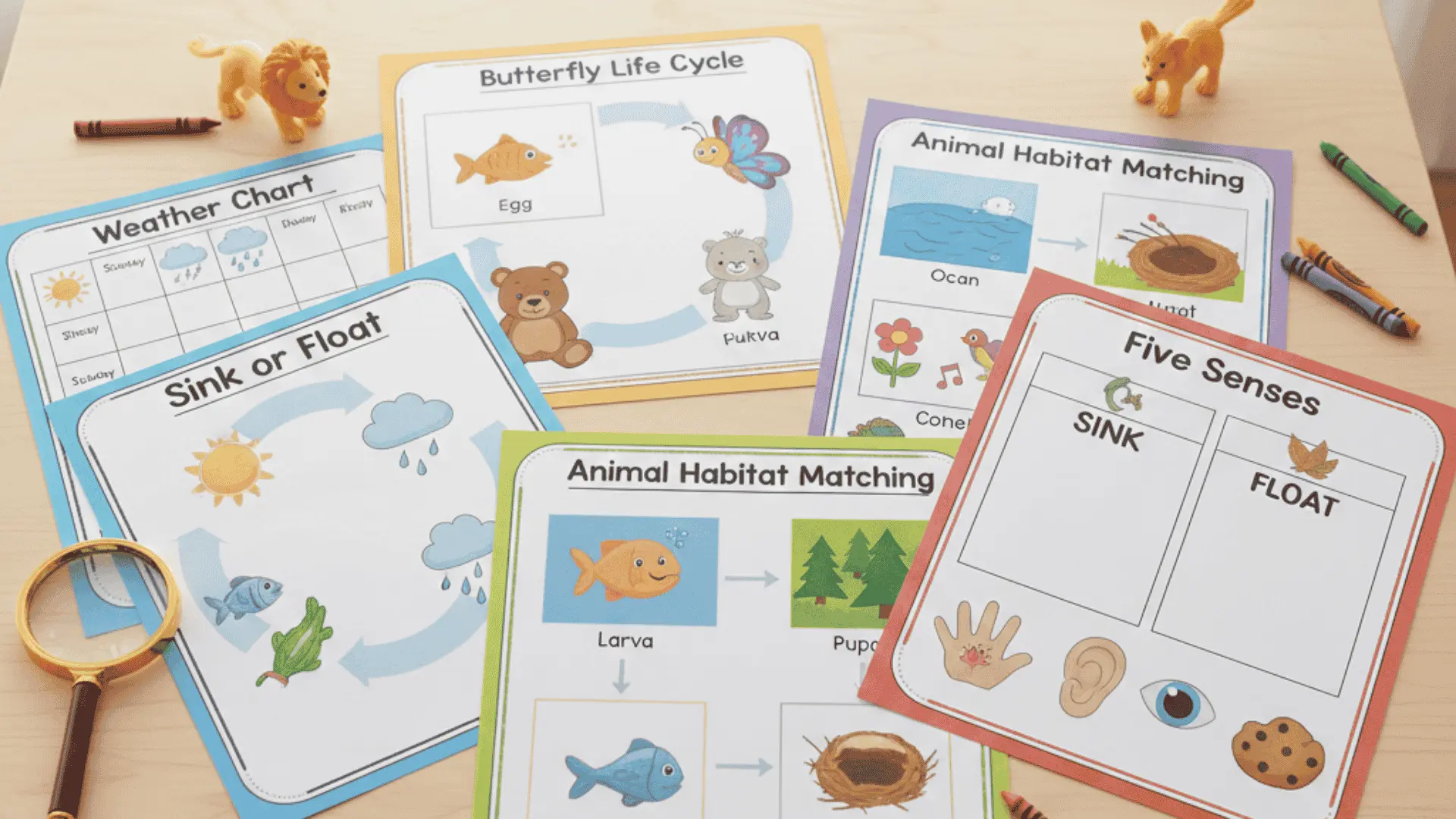
These printable science activities for kindergarten introduce young learners to the world around them. Each worksheet encourages kids to observe, sort, and think about nature and everyday experiences.
29. Weather Chart Printable
Kids check the weather each day and record it on their chart using simple symbols or words.
This builds observation habits and introduces basic science vocabulary, such as sunny, cloudy, and rainy.
It also works as a daily classroom routine. Consistent use helps kids see patterns in the weather over days and weeks.
30. Seasons Sorting Worksheet
Kids look at pictures and sort them into the correct season based on what they see. A snowy scene goes under winter. A blooming flower goes under spring.
This activity connects science to real-life experience. It is one of the more natural kindergarten activities for helping kids think about how the world changes throughout the year.
31. Life Cycle of a Butterfly Printable
This worksheet guides kids through the four stages of a butterfly’s life cycle, from egg to adult.
Kids label or sequence the stages in order. It introduces the idea that living things change and grow over time.
A clear, visual format makes this concept approachable for young learners without requiring prior knowledge.
32. Plant Growth Observation Sheet
Kids draw or write what they notice as a plant grows over several days or weeks. This teaches them to slow down and look closely at changes happening over time.
It also introduces basic science recording skills. Paired with a simple classroom planting project, this becomes one of the more hands-on activities for kindergarten science.
33. Animal Habitat Matching Activity
Kids match each animal to the habitat where it naturally lives, such as a fish with the ocean or a bear with the forest. This builds vocabulary and introduces the concept that animals have specific needs.
It works well as an independent activity and opens up good conversations about why animals live where they do.
34. Sink or Float Recording Sheet
After testing objects in water, kids record their results on the sheet by circling or drawing whether each item sank or floated. This turns a simple experiment into a structured learning moment.
It introduces basic scientific thinking, including making predictions and recording outcomes. A natural fit for hands-on kindergarten activities that connect doing with learning.
35. Five Senses Worksheet
Kids identify which sense they would use to experience different things, such as hearing music or smelling a flower. This activity builds body awareness and science vocabulary at the same time.
It is easy to connect to real-world examples, which makes the concepts stick. A simple but effective addition to any science-focused activities for kindergarten.
Science and exploration activities encourage kindergarten children to observe, question, and know the world around them. Through simple experiments, nature walks, and hands-on exploration, kids develop curiosity and build a strong foundation for early science learning.
Social Skills and Emotional Learning
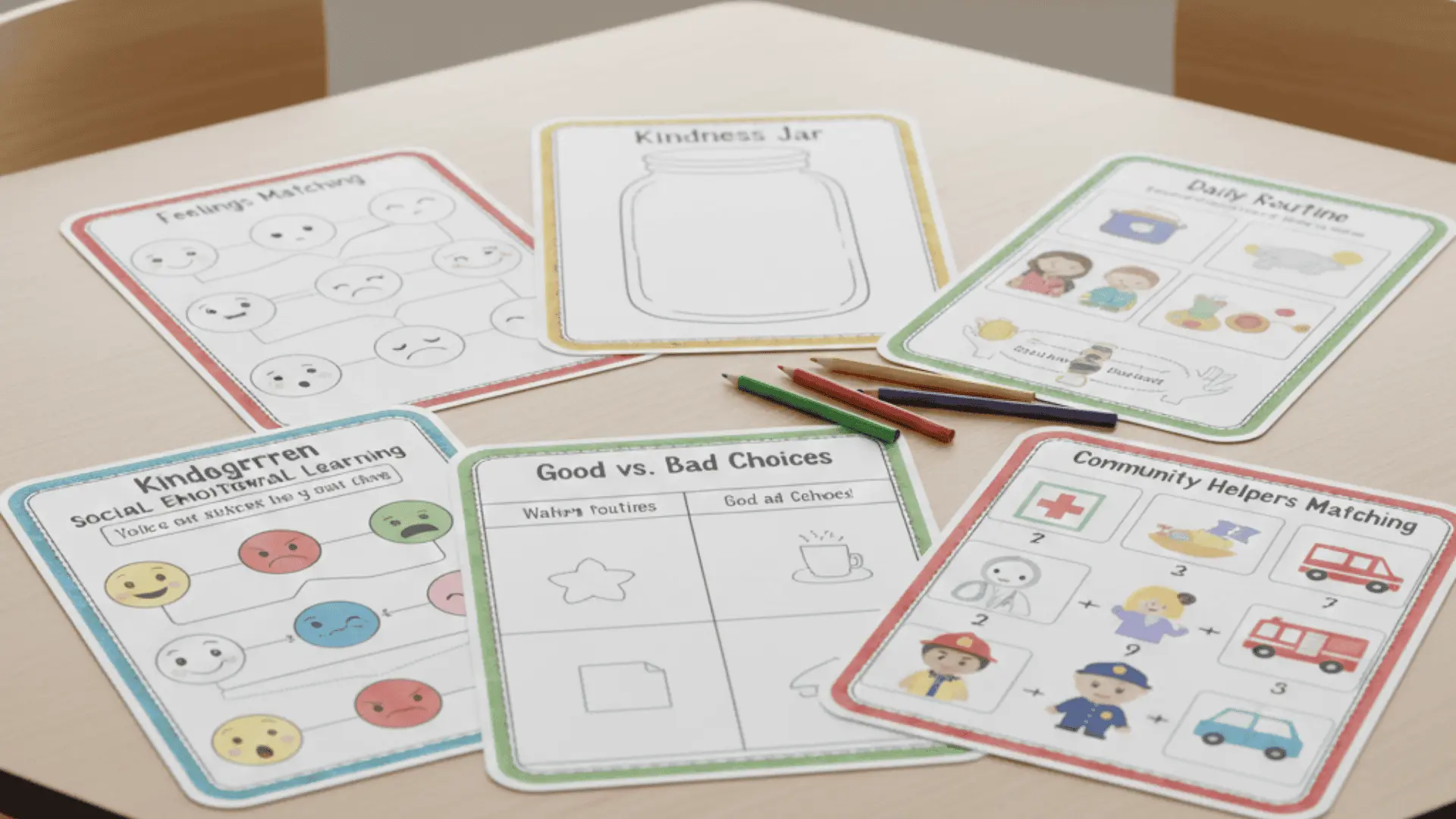
These printable social and emotional learning activities for kindergarten help kids understand feelings, make good choices, and build the basic life skills they need in and out of the classroom.
36. Feelings Matching Worksheets
Kids look at facial expressions and match them to the correct feeling word, such as happy, sad, or angry. This helps children build emotional vocabulary at an early age.
When kids can name what they feel, it becomes easier for them to manage it. A simple but meaningful addition to kindergarten activities focused on self-awareness.
37. Kindness Activity Pages
These pages ask kids to think about kind actions and how they affect others. Kids might draw a kind thing they did or circle the kindest choice in a given situation.
It reinforces positive behavior in a low-pressure format. These are the kinds of activities for kindergarten that support character development alongside academic learning.
38. Good Choices vs Bad Choices Sorting
Kids look at pictures of different behaviors and sort them into two groups, good choices and not-so-good ones. This builds decision-making skills and encourages kids to think before they act.
It works well as a discussion starter, too. Talking through each picture as a group adds depth to what is otherwise a straightforward kindergarten activity.
39. Daily Routine Sequencing Sheets
Kids put pictures of daily activities in the correct order, such as waking up, brushing teeth, eating breakfast, and going to school. This builds sequencing skills while also reinforcing the value of routine.
It is a comfortable, familiar topic for young learners. That familiarity makes it one of the easier activities to introduce in kindergarten without much explanation.
40. Community Helpers Matching Activity
Kids match each community helper to the tool or place connected to their job, such as a firefighter with a fire truck or a doctor with a stethoscope. This builds vocabulary and broadens a child’s understanding of the people around them.
It works well as an independent activity and fits naturally into any social studies or kindergarten activity unit on community.
Social skills and emotional learning activities help kindergarten children understand their feelings and interact positively with others.
Seasonal and Themed Activities
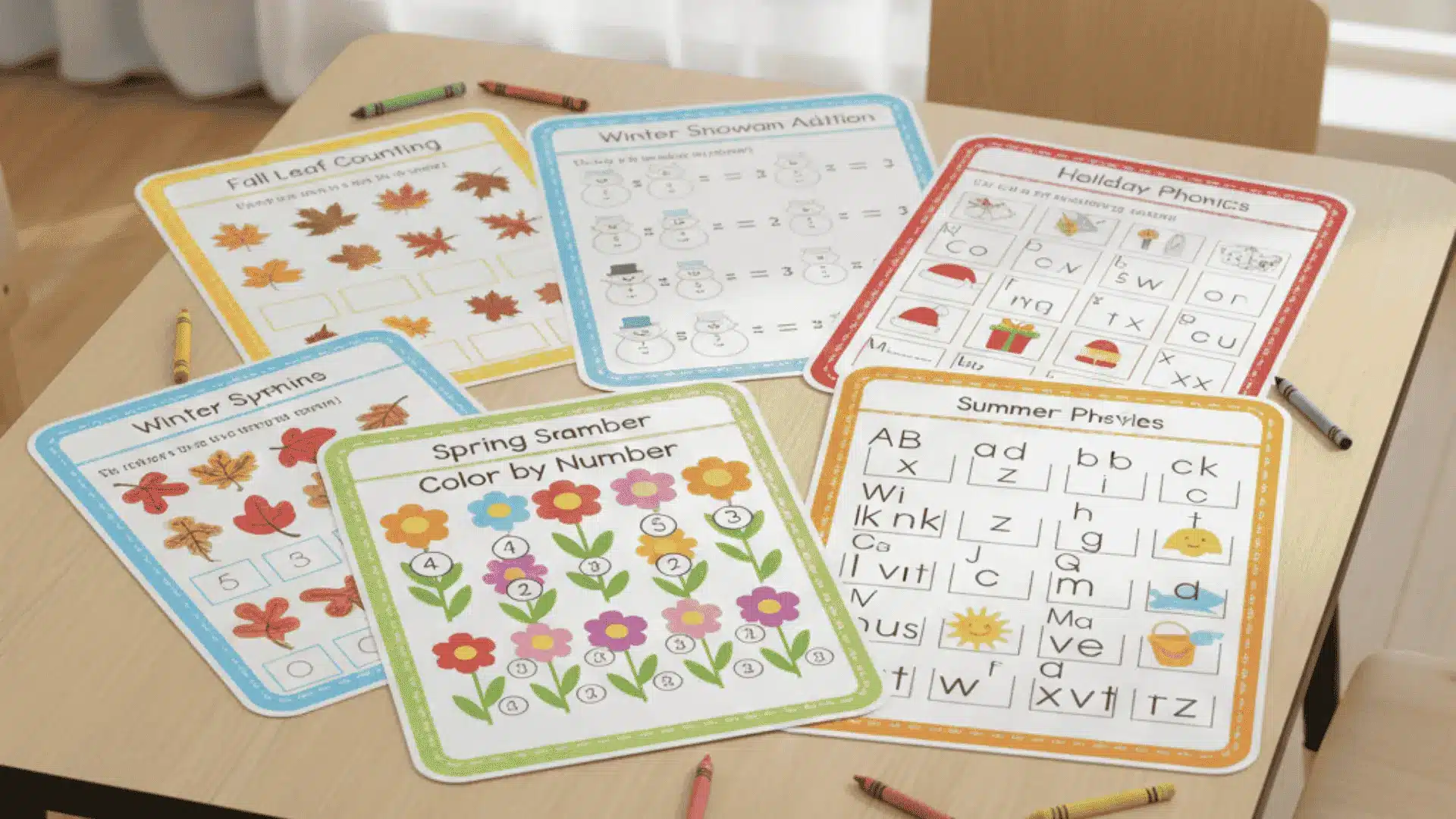
These printable seasonal activities for kindergarten keep learning fresh throughout the year. Each themed worksheet ties core academic skills to holidays and seasons kids already look forward to.
41. Fall Leaf Counting Worksheets
Kids count the leaves in groups and write the matching number on each page. The fall theme makes the activity feel current and connected to what kids see outside.
It is a simple way to keep number practice going without using the same worksheets all year. A natural fit for autumn kindergarten activities at home or in the classroom.
42. Winter Snowman Addition Printable
Kids solve simple addition problems laid out across a snowman-themed page. The familiar winter images keep the mood light while the math stays focused.
This works well during the holiday season when kids are excited and easily distracted. Themed activities for kindergarten help hold attention without pulling focus away from the actual skill being practiced.
43. Spring Flower Color by Number
Kids solve number problems and use the answers to color sections of a flower-themed picture. It combines basic math with a hands-on coloring task.
The spring theme gives the activity a seasonal feel that matches what is happening outside. A good option for keeping kindergarten activities connected to the time of year.
44. Summer Alphabet Review Sheets
These sheets review letters and sounds using summer-themed images like suns, sandcastles, and beach balls. They work well at the end of the school year or as part of a summer learning pack.
Kids get to revisit what they have learned without it feeling like a test. A low-pressure way to close out the year with familiar kindergarten activity skills.
45. Halloween Beginning Sounds Activity
Kids look at Halloween-themed pictures and identify the beginning sound of each one.
A pumpkin starts with “P.” A bat starts with “B.”
The theme adds a seasonal spark to a standard phonics task. It is one of those kindergarten activities that kids tend to sit down for willingly because the pictures already hold their attention.
46. Thanksgiving Counting Worksheets
Kids count groups of Thanksgiving-themed objects, such as turkeys, acorns, or pumpkins, and record the correct number. The familiar holiday images make the activity feel special rather than routine.
These worksheets fit naturally into November lesson plans. They cover core counting skills while giving kindergarten activities a seasonal connection kids can relate to.
47. Christmas Sight Word Match
Kids match sight words to their correct pairs using a Christmas-themed layout featuring images such as ornaments, stars, and gift boxes. The holiday format keeps engagement up during a time when focus can be hard to hold.
It is a practical way to keep sight word practice going in December. A seasonal twist on one of the most consistent kindergarten activities used throughout the year.
Creative and Thinking Activities
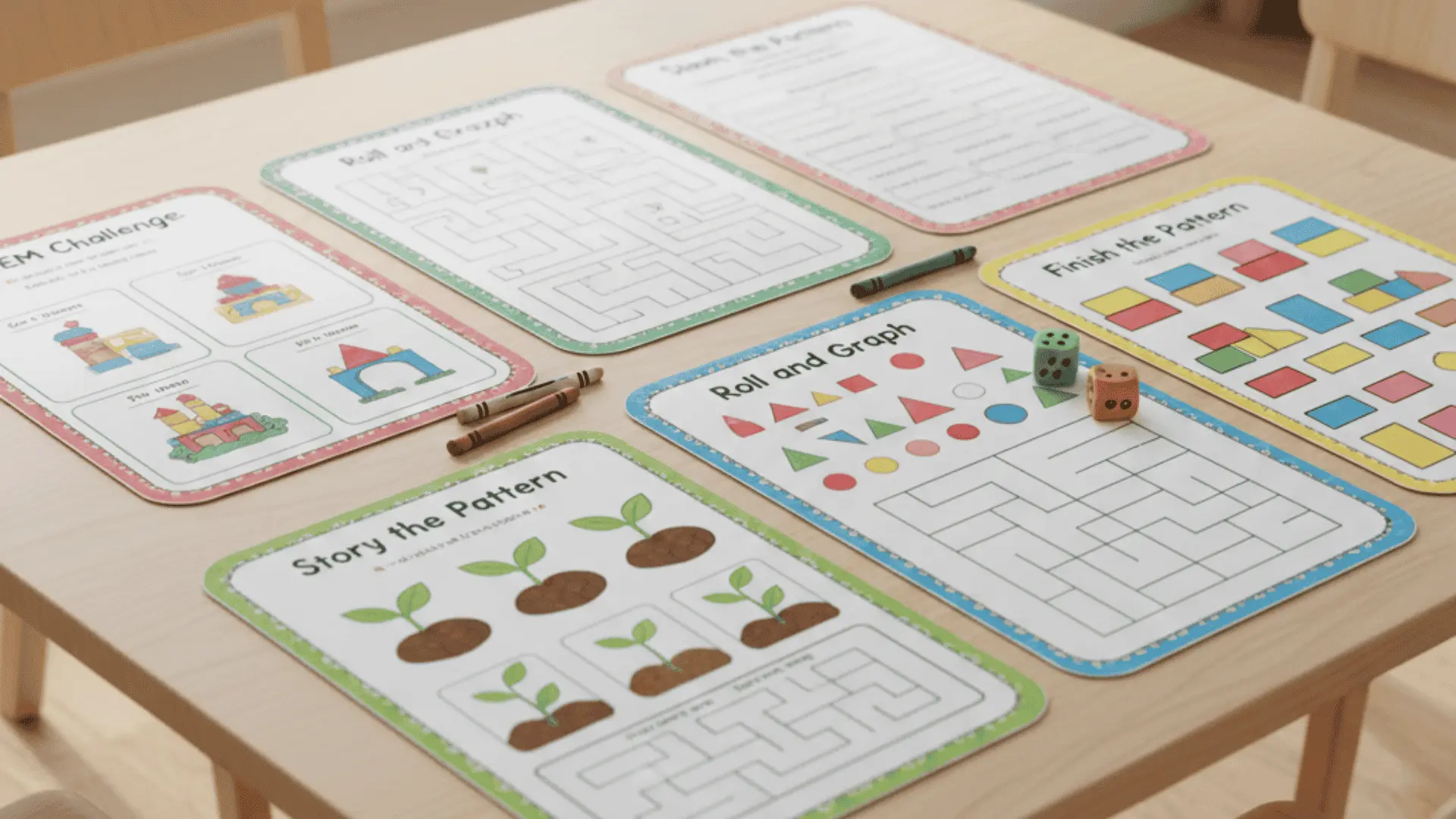
These printable, thinking, and creative activities for kindergarten go beyond basic drills. Each one asks kids to reason, problem-solve, and engage more actively with learning.
48. Printable STEM Challenge Cards
Each card gives kids a simple building or problem-solving task using everyday materials. Kids are asked to think through a challenge and try different solutions until something works.
This builds early critical thinking skills in a format that feels more like play than structured work. A strong addition to kindergarten hands-on activities that go beyond pencil-and-paper tasks.
49. Puzzle and Problem-Solving
These worksheets ask kids to figure something out rather than just fill in an answer. Tasks might include visual puzzles, pattern problems, or simple logic challenges.
Working through these builds patience and reasoning skills. They are a good fit for kindergarten activities that push kids to think a little harder without making the work feel overwhelming.
50. Roll and Graph Math Game
Kids roll a die, record the result, and graph how many times each number appears. It covers number recognition, counting, and basic graphing in one activity.
The game-style format keeps kids motivated to keep going. This is one of those kindergarten activities that blends math practice with enough fun to hold a young learner’s attention.
51. Story Sequencing Picture Cards
Kids look at a set of picture cards showing different parts of a story and place them in the correct order. This builds reading comprehension and logical thinking at the same time.
It works well in small groups or as an independent task. A practical and repeatable kindergarten activity that supports both literacy and critical thinking skills.
Creative and thinking activities encourage kindergarten children to use their imagination while developing problem-solving skills.
Click hereto download a free printable worksheet.
Tips for Making Kindergarten Worksheets More Fun
A few small changes can make a big difference. These tips help keep kids engaged while working through kindergarten activities at home or in class.
- Add Manipulatives: Place small objects, such as buttons or coins, on worksheets to make kindergarten counting and sorting activities more hands-on and concrete.
- Use Stickers and Stamps: Let kids mark answers or celebrate completed sections with stickers. It adds a rewarding touch to standard worksheet practice.
- Turn Worksheets Into Games: Set a timer, earn points, or race through problems together. Friendly challenges make kindergarten activities feel less like work.
- Use Short Learning Sessions: Keep sessions to 10 or 15 minutes. Shorter, focused bursts work better than long sitting periods for most kindergarten-aged children.
- Let Kids Choose Their Activity: Giving children a say in which worksheet they do first builds a sense of control and keeps resistance low during learning time.
Making kindergarten worksheets more fun helps children stay engaged and motivated while learning. Adding colors, games, stickers, and interactive elements can turn simple worksheets into enjoyable activities that support both creativity and skill development.
Final Thoughts
Kindergarten is a big year for learning, and the right activities can make a real difference. From alphabet tracing to STEM challenge cards, the printables given cover every key skill area young learners need.
They are easy to prepare and simple to use activities for kindergarten, built around what kids this age are ready to learn.
The best part is that none of this has to be complicated. A few good worksheets, a little consistency, and some patience go a long way. Start with one or two activities that match a child’s current skill level and build from there.
Which section was most helpful for you? Leave a comment below and share this with a parent or teacher who could use it. Bookmark this page so it is easy to find when you need it.