



Ever wondered what to call your cousin’s new baby? You’re not alone.
Your cousin’s kids are your first cousins once removed. This means there’s a one-generation gap between you.
You and your cousin are in the same generation, but your cousin’s children are one generation below, making them “once removed.”
This blog explains what are your cousins kids to you and why everyone gets it wrong and what people actually say in real life.
You’ll learn a simple method to figure out any cousin relationship without confusion.
Why Your Cousin’s Child Is “Once Removed”
The word “removed” in cousin relationships means generations apart.
Each generation gap adds another “removal” to the relationship. It’s not about emotional distance or how close you are to someone.
It’s purely mathematical and based on your family tree position.
Here’s how it works:
- One generation apart: once removed
- Two generations apart: twice removed
- Three generations apart: three times removed
The removal count increases with each generation gap. Your cousin’s grandchildren would be your first cousins twice removed because there are two generations between you.
Family Relationship Breakdown (Step-by-Step)
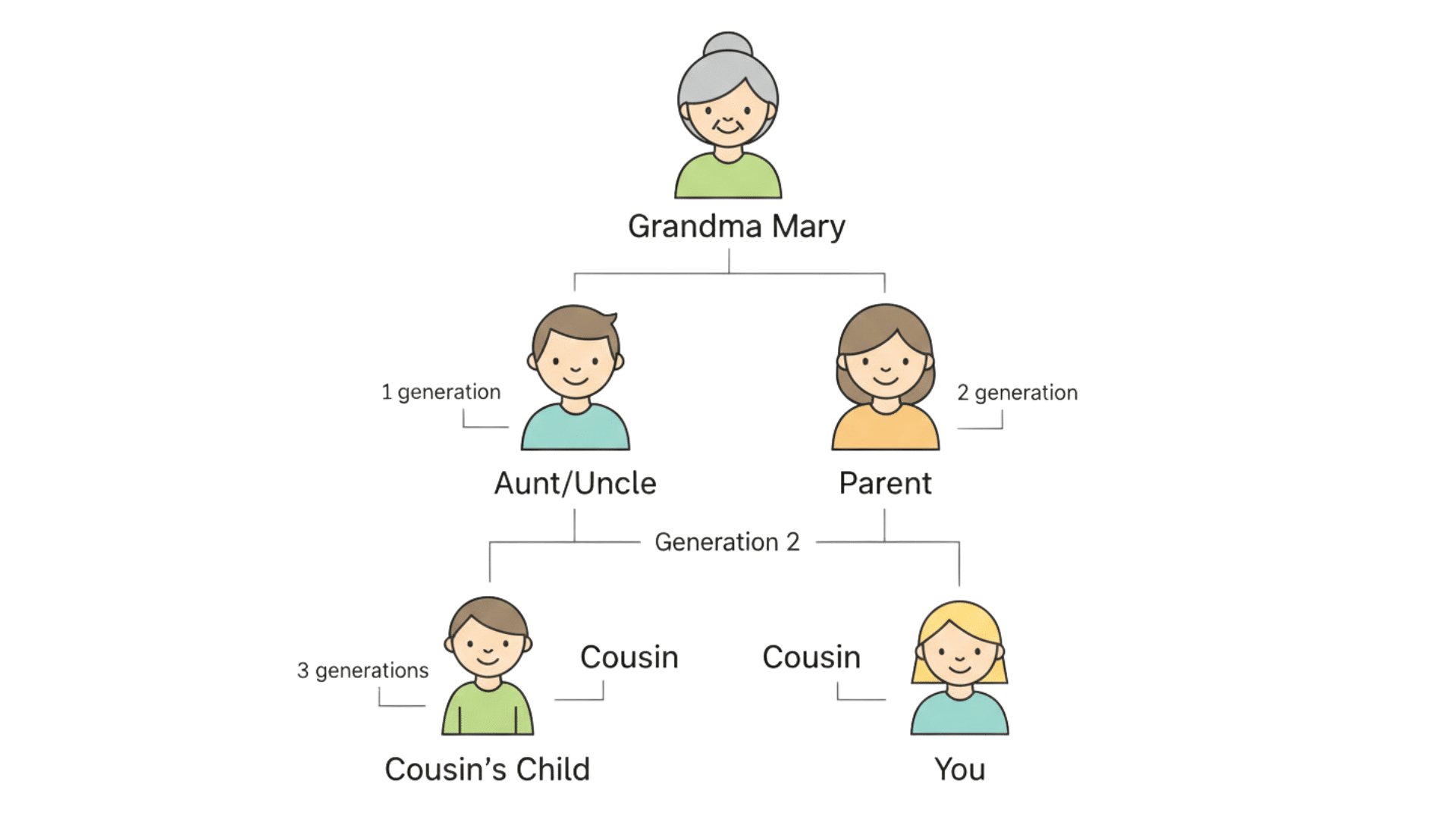
Confused about cousin terminology? This simple method works for any cousin relationship, no matter how complicated it sounds.
Step 1: Find Your Common Ancestor
Look for the closest ancestor you both share. This is usually a grandparent or great-grandparent.
Example: You and your cousin both share Grandma Mary.
Step 2: Count Generations From YOU to That Ancestor
Count how many steps up the family tree from you to your shared ancestor.
Example: You to Your Parent to Grandma Mary: 2 generations
Step 3: Count Generations From THEM to the Same Ancestor
Now count the steps for the other person.
Examples:
- Your cousin: Cousin to Their Parent to Grandma Mary: 2 generations
- Your cousin’s child: Cousin’s Child to Your Cousin to Aunt/Uncle to Grandma Mary: 3 generations
Step 4: Find the Cousin Number
Take the smaller of your two generation counts and subtract 1.
- Smaller number is 2: First cousins
- Smaller number is 3: Second cousins
- The smaller number is 4: Third cousins
Formula: Cousin number: (smaller generation count minus 1)
Step 5: Calculate “Removed”
Find the difference between your two generation counts.
- Difference is 0: Not removed
- Difference is 1: Once removed
- Difference is 2: Twice removed
Step 6: Put It Together
Combine the cousin number with how many times removed.
Examples:
- First cousin plus no difference: First cousins
- First cousin plus difference of 1: First cousins once removed
- Second cousin plus difference of 2: Second cousins twice removed
Quick Memory Trick
Same generation: no “removed.”
Different generations: “removed.”
If you and the other person are the same number of steps from your common ancestor, you’re just cousins (first, second, or third). No “removed” needed.
If there’s a generation gap between you, that’s when “removed” comes in.
This method works every single time, whether you’re figuring out your relationship to your cousin’s grandkids or your grandparent’s cousin. Just count the generations and do the simple math!
Visual Relationship Table
| Relationship | Correct Family Term |
|---|---|
| Your cousin and you | First cousins |
| Your cousin’s child and you | First cousins once removed |
| Your child and your cousin | First cousins once removed |
| Your child and your cousin’s child | Second cousins |
| Your parents’ cousin and you | First cousins once removed |
| Your cousin’s grandchild and you | First cousins twice removed |
| Your grandchild and your cousin’s grandchild | Third cousins |
What Do Other People Actually Say?
In real life, most people skip the technical terms altogether. Here’s what you’ll actually hear at family gatherings:
- “My cousin”: Many say “my cousin” for any extended cousin relationship, regardless of how accurate it is.
- “My cousin’s daughter/son”: Others use descriptive phrases like “my cousin’s daughter” or “my cousin’s son” to avoid the confusing terminology altogether.
- “Aunt” or “Uncle”: Some families, especially with younger children, use “aunt” or “uncle” even when it’s not technically correct because it’s easier and feels warmer.
- “My second cousin”: You’ll also hear people say “my second cousin” when they really mean first cousin once removed, since that’s a common mix-up.
- Just first names: In casual conversation, most people use first names and skip the relationship label entirely.
Very few people outside of genealogy enthusiasts actually use “first cousin once removed” in everyday speech.
Is It Wrong to Call Them Your Niece or Nephew?

Technically, yes. Your nieces and nephews are only your siblings’ children, not your cousins’ kids.
Your cousin’s children are actually your first cousins once removed. However, many families use “niece” and “nephew” anyway because they’re simpler and sound more affectionate.
Kids also find it easier to say “Aunt” or “Uncle” instead of complicated cousin terms.
For everyday conversation, use whatever feels natural to your family.
Just remember to use the correct relationship on official documents like medical forms, legal papers, or family trees where accuracy matters.
Does This Change in Other Cultures or Languages?
- Chinese and Asian languages: They have separate words for maternal versus paternal cousins and different terms for older versus younger cousins.
- Spanish-speaking cultures: They use “primo” for most cousins and often call older relatives “tío” and “tía” (aunt/uncle) as a sign of respect, even if they’re cousins.
- Arabic cultures: They use specific terms showing whether the cousin is from the father’s or mother’s side, which is culturally significant.
- Indian languages: They have different words for every cousin type based on age, gender, and which side of the family.
- Scandinavian languages: They keep it simple, using one word like “kusin” for all cousin relationships.
Conclusion
Your cousin’s kids are your first cousins once removed, simple as that. The “once removed” just means there’s one generation between you.
Use the technical term for official documents, but in everyday life, call them whatever feels natural to your family.
Whether it’s “my cousin’s kids,” just “cousin,” or even “niece and nephew,” what matters most is the connection you share.
Now you know the answer and have an easy method to figure out any cousin relationship.