


Tired of staring at bare dirt where your lawn should be? Hand-seeding takes months to fill in, and sod costs thousands even for small yards.
Hydroseeding fixes both problems. This method sprays a mixture of seed, mulch, and fertilizer onto your soil, delivering a full lawn in 6-8 weeks at 75% less than sod.
It’s how golf courses and highway slopes green up so fast.
This blog explains what is hydroseeding, how the process works, growth timelines, benefits over other methods, and what it costs. You’ll know if hydroseeding is right for your property by the end.
What Exactly Is Hydroseeding?
Hydroseeding sprays a mixture of grass seed, mulch, fertilizer, and water onto bare soil in one quick application.
A truck-mounted machine blends everything into a thick, green slurry and sprays it evenly across your lawn. The mulch locks in moisture and protects seeds from birds and erosion. The fertilizer feeds them from day one.
Grass sprouts in 5-7 days. You’ll see coverage in two weeks and a full lawn in 4-6 weeks.
It costs less than sod but more than hand-seeding. It grows faster than scattered seed but slower than sod rolls.
That makes it perfect for residential lawns, slopes, and large commercial areas.
How Does Hydroseeding Work?
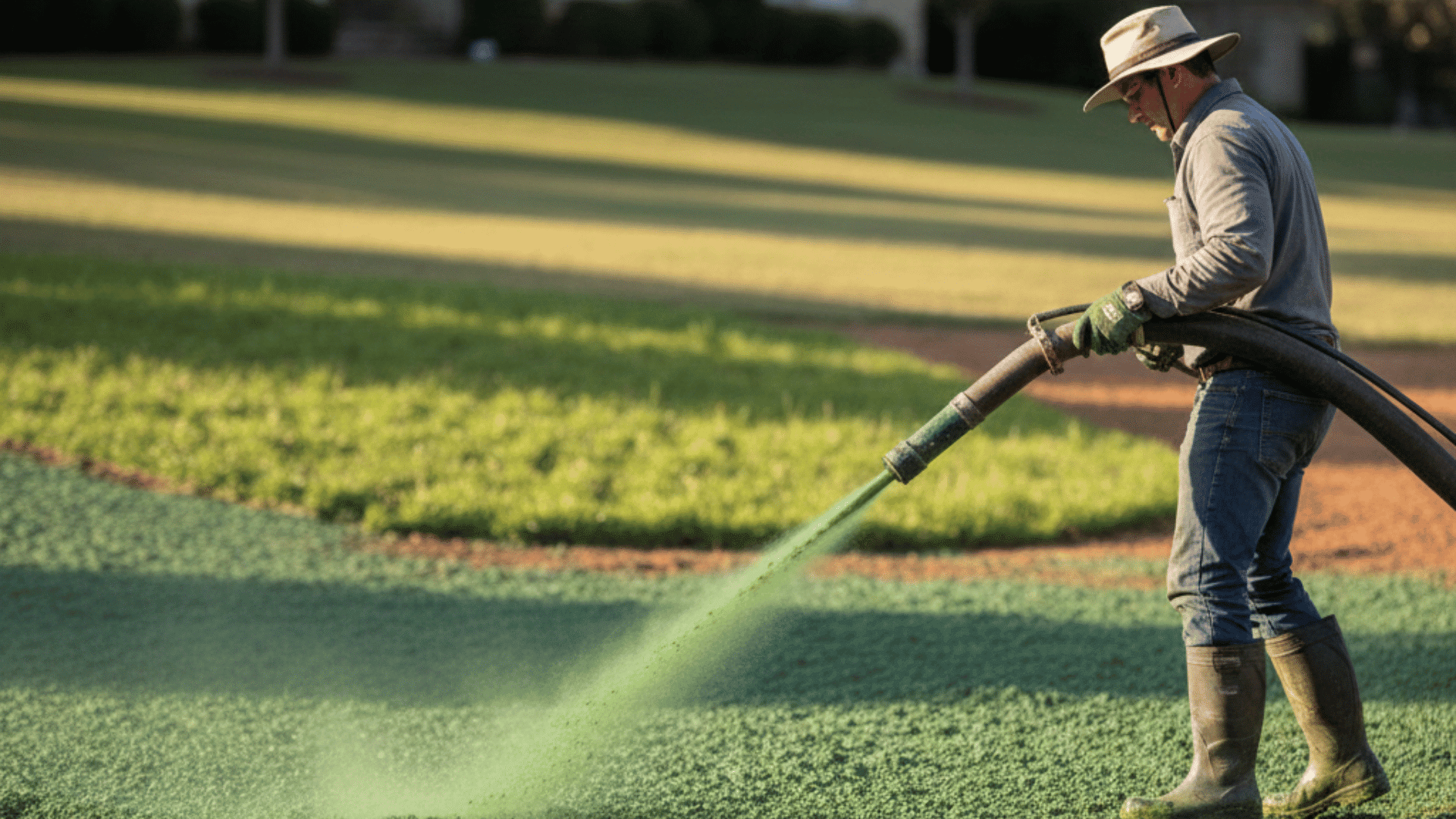
Hydroseeding changes bare soil into a full lawn in seven straightforward steps.
Step 1: Site Preparation
Professionals assess your soil, drainage, and sun exposure. They clear debris, grade for drainage, and till the top 2-4 inches.
Soil amendments like lime or compost are added if the pH needs adjusting.
Step 2: Mixing the Slurry
The technician loads the hydroseeder with water, grass seed for your climate, mulch fiber, starter fertilizer, and tackifier.
Green dye goes in last for visibility. The machine blends everything into a uniform mixture.
Step 3: Application
Using a high-pressure hose, the operator sprays the slurry evenly across the soil. The tackifier bonds it to the ground, preventing erosion.
This takes 30 minutes to 2 hours, based on lawn size.
Step 4: Germination (Days 1-10)
Water lightly 2-3 times daily to keep the mulch moist. Seeds sprout in 5-7 days. The mulch protects them from birds and holds moisture.
Step 5: Early Growth (Weeks 2-3)
Grass blades emerge and spread. Reduce watering to once or twice daily. You’ll see visible green coverage by week two.
Step 6: Root Development (Weeks 3-4)
Switch to deeper, less frequent watering every other day. This encourages strong root systems that anchor into the soil.
Step 7: First Mowing (Weeks 4-8)
Mow when the grass hits 3-4 inches, using the highest blade setting. By week 6-8, your lawn is mature and ready for normal care.
The application takes half a day. Full establishment takes 6-8 weeks.
What Is Hydroseeding Used For?
Hydroseeding works for projects needing fast, affordable grass coverage across various terrains and sizes.
- Residential Lawns: Homeowners use it for new lawn installation, bare spot repairs, and full yard renovations. It’s faster than hand-seeding and cheaper than sod.
- Steep Slopes and Hillsides: The tackifier bonds to sloped terrain, preventing seed washout and soil erosion. Perfect for embankments, hillside properties, and graded slopes.
- Erosion Control: Construction sites and land developments use hydroseeding to stabilize disturbed soil quickly. The mulch mat stops wind and water erosion while grass roots anchor the ground.
- Commercial Properties: Golf courses, parks, sports fields, and office complexes rely on hydroseeding for uniform coverage across large areas at lower costs than sod.
- Highway Projects: Transportation departments hydroseed roadside ditches, medians, and shoulders to control erosion and create green buffers along roads.
- Athletic Fields: Schools and recreation centers use it for football fields, soccer pitches, and play areas that need durable turf for heavy foot traffic.
- Restoration Sites: Fire-damaged areas, flood zones, mining sites, and cleared land get hydroseeded to restore vegetation and prevent further soil damage.
Hydroseeding handles any project, from small yards to hundreds of acres, from flat ground to steep slopes.
How Long Does Hydroseeding Take to Grow?
Hydroseeding delivers visible results quickly, with full lawn establishment in 6-8 weeks.
| Growth Stage | Timeline | What Happens |
|---|---|---|
| Germination | 5-7 days | First grass blades emerge through the mulch. Fast grasses like ryegrass sprout in 5-7 days; slower varieties like Kentucky bluegrass take 10-14 days. |
| Visible Coverage | 2-3 weeks | Green coverage spreads across the lawn. Grass is tender but clearly established. |
| First Mowing | 3-4 weeks | Grass reaches 3-4 inches tall. Mow at the highest blade setting, removing only the top third. |
| Full Establishment | 6-8 weeks | The lawn is mature with deep roots. Ready for normal foot traffic and regular maintenance. |
Factors That Affect Growth Speed
- Grass Type: Ryegrass: 5-7 days. Fescue: 7-14 days. Kentucky bluegrass: 14-21 days.
- Temperature: Best at 60-75°F. Cold slows growth; heat stresses seedlings.
- Watering: Daily watering for 2-3 weeks is essential. Inconsistency delays growth.
- Soil Quality: Rich, loose soil accelerates growth. Poor soil slows it.
- Season: Spring and fall are ideal. Summer and winter slow the establishment.
Hydroseeding establishes 2-3 times faster than hand-seeding, delivering a usable lawn in about half the time.
Benefits of Hydroseeding
Hydroseeding offers key advantages that make it the preferred choice for many lawn projects.
- 75% Cheaper Than Sod: Get professional lawn results at a fraction of sod’s cost while still outperforming hand-seeding.
- Fast Germination: Grass sprouts in 5-7 days, and you’ll have a full lawn in 6-8 weeks, 2-3 times faster than traditional seeding.
- Superior Erosion Control: Tackifier bonds to soil instantly, making it ideal for slopes, hillsides, and areas where hand-seeding would wash away.
- Uniform, Even Coverage: Spray application eliminates the bare spots and patchy growth you’d get from broadcasting seed by hand.
- Stronger Root Systems: Seeds germinate directly in your soil, creating deeper roots than transplanted sod. This means better drought resistance and long-term durability.
- Works on Difficult Terrain: Handles steep slopes, rocky ground, and large properties where sod installation would be impractical or impossible.
Hydroseeding delivers the perfect balance of speed, cost, and quality for lawn establishment.
Is Hydroseeding Different from Regular Seeding or Sod?
Yes, hydroseeding differs significantly in application, cost, and results.
Hydroseeding vs. Regular Seeding
Hydroseeding sprays a liquid mixture of seed, mulch, fertilizer, and water. Regular seeding scatters dry seed with no protection.
Hydroseeded grass sprouts in 5-7 days versus 2-3 weeks for hand-seeded grass.
The mulch retains moisture and prevents washout on slopes, while regular seed washes away. Hydroseeding provides uniform coverage; hand-seeding creates patchy areas.
Hydroseeding vs. Sod
Hydroseeding sprays a mixture in hours with minimal labor. Sod requires laying heavy rolls.
Hydroseeding costs 75% less and produces a mature lawn in 6-8 weeks. Sod gives instant coverage but needs 2-3 weeks to root.
Hydroseeded grass develops deeper roots; sod roots start shallow.
Hydroseeding works on steep slopes where sod is impractical.
Hydroseeding is faster than hand-seeding and more affordable than sod, with superior root development.
Conclusion
Hydroseeding offers the best balance; it is faster than hand-seeding, cheaper than sod, and works on any terrain.
With grass sproutinwhat is hydroseeding in 5-7 days and full establishment in 6-8 weeks, you get professional results at an affordable price.
If you’re installing a new lawn, repairing bare spots, or stabilizing slopes, hydroseeding delivers uniform coverage and strong root development efficiently.
Ready to change your bare soil? Get quotes from local hydroseeding professionals and start growing your lush, green lawn today.